Enchanted Realms Rulebook
Phylum: Giantkin
As its name suggests, one of the main criterion for the phylum giantkin is the physical size of those in it. The other significant factor is an upright structure based on a bipedal form. To be fair, there is a little wiggle room in the interpretation here because some of the giantkin don’t have exactly two legs. However, their skeleton structure is based on a over-sized hominoid generality. However, the key component is the signature of their lifesongs. Giants have ancient ancestral roots from the elemental planes. No one believes they were originally inhabitants there but there are various theories on why they have some of the shared energies of elemental beings. Nonetheless, giants breed amongst their own kind, breath, eat and sleep. They also have pure vigor in their lifesongs, distinctly categorizing them as zoola.
Class: Horgus
The horgus class of giantkin are all related cousins from millennia of uncontrolled breeding with some ancient hereditary energies that do not even exist in Enchanted Realms any longer. In many ways, the horgus are to the giants as orcs are to hominoids; they are essentially “mutt breeds” that have held a consistent population to essentially be their own particular species. Finally, while not a universal trait for giantkin, many of the horgus species have developed a sinister palette and are man-eaters, happily devouring nearly any of the hominoids.
Bulgu

Zoola Giantkin Horgus
Standing nearly nine feet tall, the Bulgu is a fearsome ogre-like being with four eyes, a head like an axe blade, arms like axe handles, and stocky legs like pestles. The beast has a voracious appetite for humanish flesh.
Draugr
Zoola Giantkin Horgus
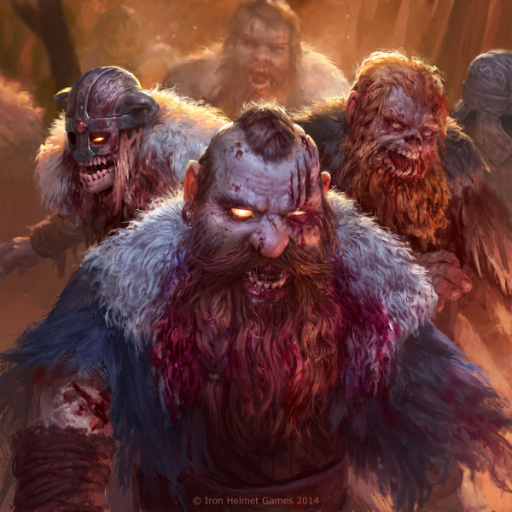
Often mistaken for undead, draugr are smaller and more intelligent cousins to trolls. Due to their size, many do not realize these species is actually in the giantkin phylum. They resemble dark-skinned dwarves, and some become capable of speech. However, these little creatures have uncanny regenerative powers, as their name literally means “again walker.” At the end of each of its turns, a draugr restores 3 points of Body. However, they cannot split to breed like trolls do. The portion no longer connected to the head merely rots, where the main body regenerates. Even dropped to zero, the draugr will regenerate; however, if dropped into the negatives, the dark dwarf will not recover for three to five minutes. It is during this time of inactivity that one can truly be destroyed. A hero must decapitate the draugr then quickly burn it to ash. Even then the ashes can regrow over about a year unless those ashes are not thrown into a lake, sea or ocean. To make matters worse, draugr are immune to normal, wood and iron weapons. Weapons of steel, magical ones, spells or fire are needed to harm one.
Brass:Immune|Bronze:Immune|Tin:Immune|Zinc:Immune|Copper:Immune|Steel:Resist
Fomhóraigh
Zoola Giantkin Horgus
Grýla
Zoola Giantkin Horgus
Hulking Wrath
Zoola Giantkin Horgus
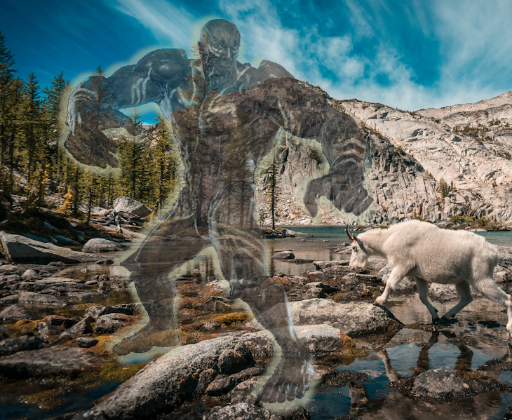
A hulking wrath is a quasi-corporeal avatar that protects the crag giants. It is not a living being in the traditional sense, but a spiritual vessel through which the divine powers nourished by the worship of the crag giants express their boundless voracity. Whenever it manifests physically, it takes on the appearance and lifesong characteristics of a horgus giantkin, making it nearly indistinguishable from one save for its supernatural nature. For that reason, it is listed here among the giants; however, its true form when not materialized, these would be considered to be a fidelithan, probably classified as a dark fey.
When attacking from range, rather than hurling material boulders, a hulking wrath will launch a spiritual projectile, which looks similar to a giant stone; however, when striking an opponent it inflicts damage to one's Spirit as well as flooding spite into the victim's soul. They also have a limited form of truesight that allows them to identify who of the opponents are priests within 120 feet, typically making them the targets of the spiritual stones.
Monops
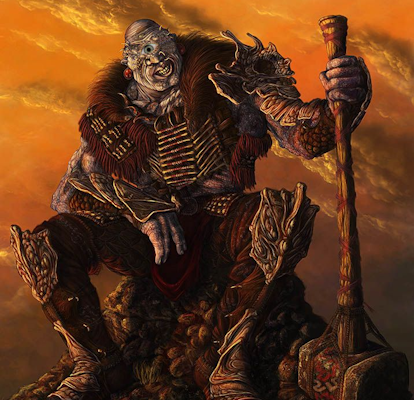
Zoola Giantkin Horgus
Ogre
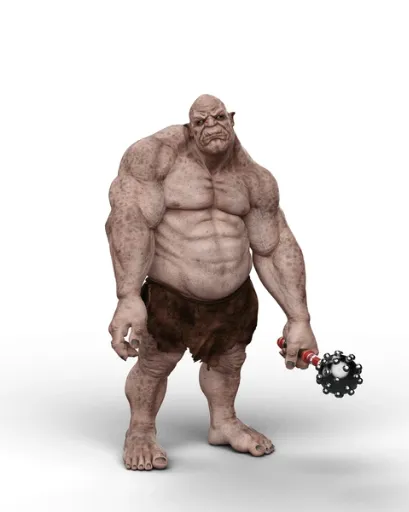
Zoola Giantkin Horgus
Ogres are between 7 and 8 feet tall and rotund, weighing around 600 pounds. They typically attack as a melee skill, but there might be a few spear-throwers. Further, within every 200 ogres there is a priest-like shaman. Ogres are tribal, inbred and have only a “mightest is the rightest” sense of justice. The number in an ogre tribe rarely exceeds twenty members. Because of their lack of order, discipline, patience and population, ogres tend to raid for their goods rather than developing craftsmanship skills. It is not uncommon for ogres to settle near goblins and steal from them or enslave them as fodder on ogre raids.
Scrag
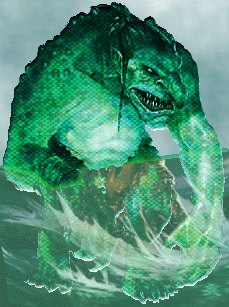
Zoola Giantkin Horgus
Scrags, the aquatic form of troll, are shorter than their land-based cousins, reaching heights from six to six-and-a-half feet. Other than this, the scrag is mostly a gilled form of the common troll; however, one is not as strong. A scrag’s colors range from blue-green to olive. Further, a scrag regenerates as a troll does at a rate of 2 points at the start of each turn; however, scrags can only regenerate when fully-immersed in water of its natural element. This is important to note as there are two variants: the fresh-water scrag and the marine scrag.
As the scrag is amphibian, able to breathe above and below the water, a common technique for its attack is to pull air-breathers below the water and drown them. With this method the scrag gains +2 to grappling competitions. However, when performing conventional combat, the scrag will swing its claws with abandon at anything that moved, biting anything close enough. If attacking the seagoing vessels of the land-bound races, one would climb onboard and weaken crew members then take one overboard to drown the victim.
Scrags have a tribal culture, with one chieftain leading a pack or small tribe of scrags -- no more than ten. The strongest and usually the smartest will be the leader, using its increased intelligence to find prey for the lessers in exchange strength in numbers. When raiding vessels or docks, up to four scrags, led by the chieftain, will go out to secure food for the rest. Despite the leader being present, it will rarely join in the attack.
An important detail to remember about trolls is they are genderless. When referring to one, the “she” is commonly used, even though it is inaccurate, as trolls reproduce through a “budding” process. This works in kind with their regenerative abilities and during “mating” season, trolls and scrags often travel alone to encourage combat so that one can be split in two to create a new lifeform.
Unlike the common troll, scrags only try to be struck during their fertile window of time. However, if during this span of time, a scrag is struck with an edged weapon or cleaver that scores a “raw 20” on the attack, its will split into two equal halves, with body points accordingly. If it is not the fertile season for a scrag but still struck with a “natural 20” of the appropriate damage type, it will sever a body part (d6: 1=left arm, 2=right arm, 3=left leg, 4=right leg, 5=head, 6=split at the waist). If out-of-season and being split or decapitated, the scrag will require an action to “pull itself together” then have a cooldown of 3d6 unmodified with a minimum of 10 seconds before it is able to resume its attacks. During this damaged state, the scrag is considered under the stunned restriction. If loosing a limb, then the fallen appendage becomes lifeless and withers. The body part will be regrown over the next two days spent immersed in water.
Due to their regeneration ability, scrags can be difficult to kill, and as they only regenerate when completely submerged in their native water, corrosives and poisons do not slow their regeneration as happens with the common troll. Those methods combined with the scrags internal body alchemy effectively neutralizes those damage types once being submerged. A scrag is one of the few monsters that will operate under the Heroes Die Hard rules.
Troll
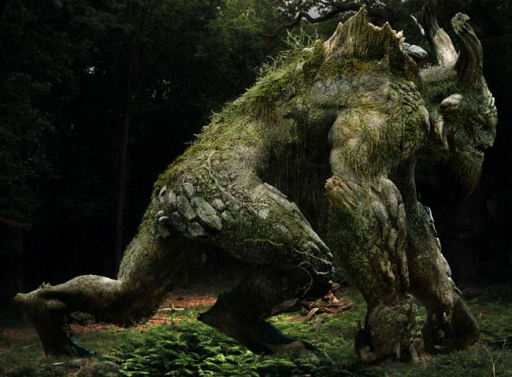
Zoola Giantkin Horgus
Standing over eight feet, trolls are ravenous, predatory species of giant humanoid found throughout almost all the regions and types of climates from arctic wastes to tropical jungles. They are uncivilized, monstrous creatures with voracious appetites that roam from one area to the next feeding upon whatever they can. Trolls are so violent but often desire to be hit. In fact, at times they lunge into attacking weapons due to their desire to reproduce by being severed. Any “raw 20” on an attack with an edged weapon or cleaver will split a troll into two equal halves, with body points accordingly.
Because of this splitting, splicing phenomenon, one might encounter a single troll that has grown extra body parts, occasionally even two heads, due to its body's regenerative response expecting the troll to have been split in half but the wound was not quite significant enough to severe completely; thus, resulting it those abnormal growths.
Further trolls regenerate at 2 points at the end of their initiative action, making them extremely difficult to kill. In fact, the only thing that reduces the regenerative powers is alchemical corrosives and poison. Five points of “acid” damage or one delivered dose of poison will block one point of regeneration for 30 minutes. Once a troll has stopped regenerating, it will die upon reaching negative 10 Body. During “mating” season, which is normally from May to June, trolls tend to travel alone. Otherwise, gangs up to six are known to exist.
Trolls typically avoid sunlight. While there is no real chance of the sun causing permanent damage, troll's skin dries out quickly as a reaction to the bright light. Their regenerative powers can keep up with the sun damage, but trolls find the experience painful — apparently even more painful than being sliced by weapons as this tends not to bother them. All this said, trolls keep to the darkness. Over a long time of adaptation, trolls have developed darkvision out to 60 feet even in total darkness.