Enchanted Realms Rulebook
Phylum: Hominoid
Class: Icthyoid
Born and most comfortable in the water, icthyoids reside underwater for most of their lives. A few species are amphibious and able to breath air on the surface land, but most are purely water-breathers. They have a human-like form, are vertebral, possess prehensile limbs and have skulls with distinct faces that have angled cheek bones.
There are areas of ambiguity for some species. Some might expect all water-residing hominoids to be classified as icthyoid; however, when a species has an aquatic breed, such as elves and hobgoblins, those species are almost always defined as a breed or variant of the other class. This is often because there is more in common with the existing class than the criteria to be in the the icthyoid class.
Cephalohauch
Cephalohauch have the upper body with human-like features, such as a head and two arms. The lower half is similar to that of a cephalopod, with a varying number of hydrostatic appendages used for locomotion.
Dajyn

Zoola Hominoid Icthyoid
The dajyn are a species of highly intelligent beings whose predominant color is a greyish-green with whiteish bellies. They are mostly shiny and slippery, but the ridges of their backs are scaly. Their forms vaguely suggest an anthropoid, but their heads are like those of fish, with prodigious bulging eyes that never close.
They are strong, quick and have developed a psionic attack from the advanced mentality. This blast of mental barrage is called derangement. Used as an action, a dajyn can pick a target by mere vision within 90 feet. The victim must make a Judgment save (TM:14) or suffer d6 Mind points of damage. Fortunate for the prey, a dajyn must wait a full minute (5 rounds) before being able to produce such an attack again. However, they often use this if they are subdued and remain conscious.
Otherwise, they will strike with weapons as due other hominoids. Their skilled training, for the warriors, acts as style-training in the weapon of choice, granting them a 2d20 attack. However, they do possess martial arts as a combat skill that allows them a d20-attack with their claws, which act as a 1-pt weapon weight bonus.
As a final combat ability, their bodies have spikes on their scales the release when struck. Effectively, if a combatant hits one within 5 feet, then their armored skin retaliates with a single point of damage.
These beings are amphibious, capable of breathing both above and below water. However, unless called to a purpose, the dajyn tend to remain below the surface. However, they are also known to inhabit the Deep Dark.
Darkvision: Extends to 60 feet
Psionic: Derangement
Frogman
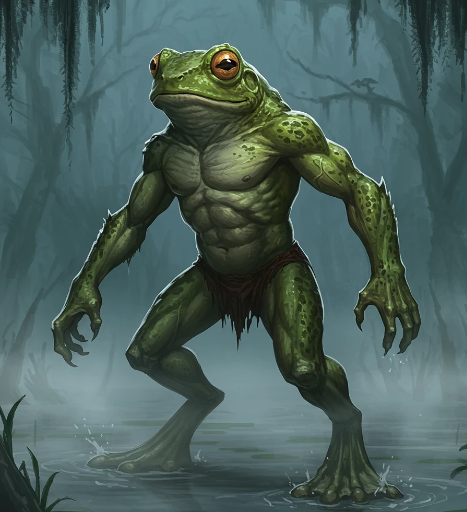
Zoola Hominoid Icthyoid
Frogmen are creatures standing about 4 to 5 feet tall with leathery skin, webbed hands and feet, and a large, frog-like head with bulging eyes that glow in the dark. Weighing roughly 60 to 90 pounds, these creatures have wrinkled, hairless, and moist skin, often described as dark, green, or grayish in color. They move via bipedal walking rather than hopping. These beings have a toxicity that oozes from its skin. When an opponent hits the frogman with a body weapon, unarmed strike, or when a creature grapples the frogman, the attacker must make a Resilience save (TM:12)or become poisoned for the following 60 seconds.
These strange amphibious bipeds have limited electrical abilities, able to produce an occasional touch-attack with an additional d4 spark of lightning. A frogman is also able to create eerie lights that appear as a will-o-wisp out to 90 feet and can create a single mirror image of oneself. Each of these peculiar abilities can be performed once per day. Not all frogmen use weapons, however, they are all able to do so.
| Variants | ||
| Boggerd | : | Fat, belligerent, frog-headed amphibious humanoids that dwell in fetid marshes and swamps. |
Gillman
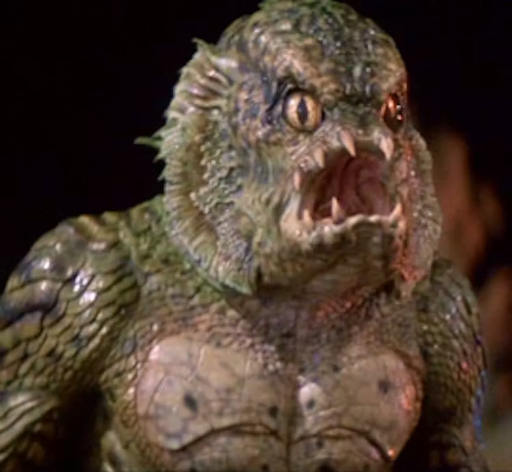
Zoola Hominoid Icthyoid
The enigmatic and reclusive "man-fish" creatures are the last of a vanished amphibious humanoid species whose ancestry dates back thousands of years, thriving in both salt and fresh water. However, they rarely leave their own aquatic communities. When encountered, the gillmen are most often protecting their own peoples’ interests. Patrols outside their living space are typically from four to six riders, using hippocampus mounts, but rarely stray farther than ten miles from their homes. Although battles between the gillmen and the saguon (sea devils) are not uncommon.
Their combatant soldiers are trained to use tridents as well as a crossbow. The gillman archery weapon can fire the same above and below water. The soldiers also have unarmed combat, but they are only able to employ such fighting underwater. Other penalties a gillman suffers for being on the surface are a considerably slower movement rate, as well as a vulnerability to fire.
Physically, gillmen resemble their ancient ancestors, with expressive brows, pale skin, dark hair, and bright purple eyes. Three slim gills mark each side of their necks, near the shoulder. They are physically stronger than the average human and are incredible swimmers. However, they are not very dexterous on the surface. Further, they are also dependent on frequent water immersion or they will weaken and potentially die. Gillmen who spend more than one day without fully submerging themselves in water risk internal organ failure, painful cracking of the skin, and death within following 2d6 hours.
Orange Lion (Swimming}
Merfolk
Saguon
amphibious hominoid, alias: sea devilSwampbug
These are a primitive race of frog-like hominoids found throughout the bogs and marshes. Born in water. amphibious.