Enchanted Realms Rulebook
Phylum: Magogen
Class: Emutareda
This class of Magogen are distinguished by some method of supernatural cross-breeding or magical fusion between two or more species. Most in this class have become procreating species without the need for the original magical power; however, there are a few exceptions.
Coeurl
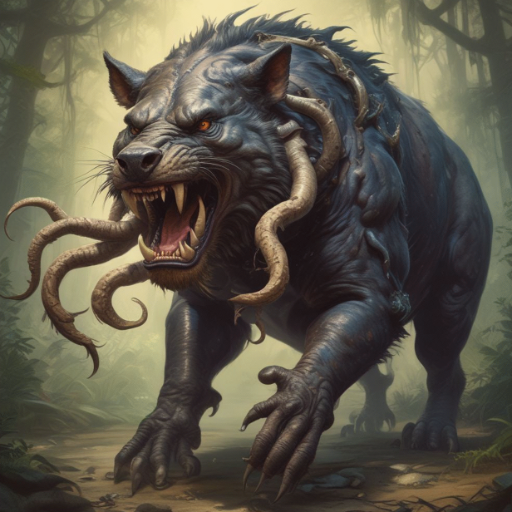
Zoola Magogen Emutareda
Often rumored to be of a feline origin, the coeurl has more of an appearance like a boar; however, its head does have catlike characteristics. In addition to these peculiar characteristics, the coeurl also has between two and six squid-like tentacles protruding from its from shoulders and chest area, giving the creature a very distinct appearance. Those tentacles deliver a powerful shock of lightning when striking a target, which has a small chance of rendering the victim incapacitated until the start of its next turn.
Further, the coeurl has an` illusionary quality that permits it to appear in a slightly different location than where it actually is. Further, it can shift its image as well. This translates those attacking being at disadvantage when battling this creature, plus the coeurl gains a +4 mystical bonus to its Defense, calculated in the Other category. Unlike the rules of other game systems, attacking this being does not force a miss-first-attempt event. However, using reveal, spirit sight or other similar effects can give an attacker the real position of the beast, which grants +4 on a to hit attack and the disadvantage penalty is removed.
Dryant
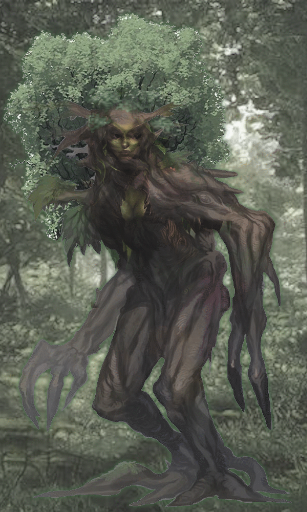
Zoola Magogen Emutareda
The dryant is a special protector of groves and forests, created by the god Uriel by fusing the life forces of a wood nymph, dryad, with that of a treant. The resulting creation is a powerful magogen being with the shape-changing ability to become an immobile tree or the form of a walking timber with a subtle feminine appearance.
A dryant has darkvision and tremorsense as enhanced methods of awareness. A dryant is also able to speak in Elvish, any local human dialects and a native ability to speak with plants. She can further perform age plant, brambles, delay disease, summon animals, and summon vines each once per day.
Similar to the treant, a dryant is vulnerable to fire; however, she is resistant to blunt and piercing damage. In addition to fire, another weakness of a dryant is she has retained her fey-nature in that weapons forged as cold iron will inflict an extra point of damage.
In combat, one will strike mighty blows with her branches and can strike combatants with a 2-hex reach. Due to its size and structure, any raw dice score of 16 or higher will strike as a heavy-blow, rendering the victim to disadvantage until the end of its next action; this attack benefit will work even against those with a shield. Lastly, a dryant can perform a special impalement reaction by pushing roots from underground up through the surface at the moment of a charging attack.
Maggot Naga
Zoola Magogen Emutareda
Maggot nagas are terrible beings of chaos, loathsome half-maggot creatures with human female upper torsos. They have a dark sense of humor and middling intelligence but are terribly cunning. They love feasting on corpses. Maggot nagas can near flawlessly mimic the voices of those they have recently feasted upon, an ability they use to make much mischief when they can.
Rajang
Zoola Magogen Emutareda
A rajang is an aggressive, oversized, four-armed ape with grayish, white fur. Its fangs and claws set it apart from a normal ape, revealing it to be a monstrous predator. This magically created species reside temperate or warm forest environments abundant with life. They share the ape’s adeptness at climbing, although these half-ton creatures shy away from scaling trees that can't support their bulk. Instead, they stalk the forest floor, lurking in narrow ravines or shallow caves, or hiding in ruined sites while waiting for prey to come near. A rajang is surprisingly stealthy, considering its size and its lack of camouflage.
They form loose bands of several individuals and their offspring, usually led by a dominant adult that also tends to be the oldest member of the group. When on the hunt away from their lair, rajang use roars and body language to communicate with one another over distance. Each individual typically hunts alone and widely separated from the others, to ensure that everyone gets adequate fodder. The leader might organize members to work together to make a big kill. If they succeed, everyone in the group shares the spoils, with the best parts going to mothers caring for their young.